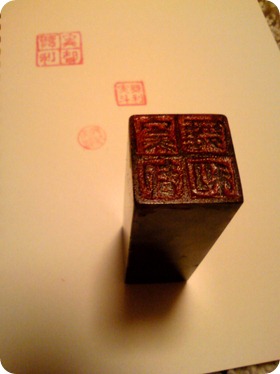
As many of you know, I kind of dabble around in sumi every once in a while. As a goodbye present to one of my schools last year, I gave them one of my paintings. One of my former co-workers remembered that this was one of my hobbies, and on his recent trip to China with his family, he had a gorgeous new stone hanko (判子) made for me! It came in a pretty gold box lined in yellow silk with a brand-new pot of shu-niku (朱肉). The stamp is a gorgeous burnt-orange stone and the shu-niku is even the good kind that smells like cheap lipstick! He dropped it off this weekend. It was great catching up, and now I can’t wait to paint something so I can use my new stamp!
 I’ve had my own personal seal since I carved my first one for sumi-e class back at Kansai Gaidai. There are a few different types of seals, but the ones I use are for artistic purposes only. These types of seals originally came to Japan from China (like basically everything else…) and are also used in Korea as well. Essentially, they are the equivalent to the western signature, or ‘John Hancock,’ if you will.
The first kind of seal is called a 実印 (jitsu-in). A jitsu-in is officially registered, and is used for legal-type-things.. such as business contracts, marriage certificates, deeds to property, etc. As well as having to be totally unique, a jitsu-in must also abide by any number of stringent regulations that have been set by the local governing body. Many people keep them in vaults or other secret places, as the possibilities for identity theft would be endless. To have an officially registered inkan, you must apply at a local municipal office for a 印鑑登録証明書 or “certificate of seal registration.”
A 銀行印 (ginko-in) is used specifically for banking. Every bank has their own rules and regulations on how big your bank seal can be, but for the most part they contain a person’s full name. For foreigners, however, anything goes, apparently. My bank told me I could register either my signature or a ginko-in with them, but I decided to register a signature, since I figured it was way more secure than registering my stamp. I do have a stamp that would be a great ginko-in, and I do use it to receive parcels or mail which is the next type of seal I’ll explain, but I would never use it as a signature for banking. Yikes. Just seems like a bad idea to me.
A 認印 (mitome-in) is a kind of moderately formal seal for signing deliveries, work memos, bill payments, and not-so-high-profile functions. They aren’t really stored as carefully as ginko-in or jitsu-in, as they are used quite often. If any of you work in a Japanese school like I do, you probably see them laying around on people’s desks. According to wikipedia, the size is totally based on your seniority in relation to the other people who will be seeing your stamp. So if you are a new guy at the company, your stamp is going to have to be smaller than your bosses’.
Here’s what my equivalent of a mitome-in looks like. It comes in a small box with its own ink pad in it, and has my first name, 舞莉実都 in a crazy font. I actually had this made thinking I was going to use it like a bank seal, but ultimately decided against it. I use it instead of signing for packages or other mail. Other than that, it’s not like my fingerprints or a signature. 
The last type of seal (and the kind I personally use the most) is called 雅号印 (gago-in), which roughly translates to ‘pen name.’ They are used by artists to sign AND decorate their work. As my sumi-e sensei would say, the stamp is the ‘spot of red’ that is absolutely necessary in the completion of one’s painting. They are mostly used for calligraphy and sumi-e, but appear in other media as well. The shape and size of gago-in can be totally freeform, as opposed to the strict legal and social guidelines that govern the other types of seals. More often than not, they are handmade by the artist. You can even get your own do-it-yourself hanko kit at a craft shop if you’d like to make one yourself! I made my own for sumi-e class back at Gaidai. I picked up the stone at a craft store and used a paperclip to carve my design. Which looks like this when stamped on a painting: When I carved this, I didn’t write 莉 with the top ‘grass’ radical but instead wrote 利 I guess it was an honest mistake. It was really difficult carving the negative space around the backwards characters (you have to make them as a mirror image on the stamp itself, otherwise it will stamp out backwards on your paper) that I was preoccupied with getting the ‘look’ right rather than the accuracy of the kanji.

Left: my hand-made gago-in for sumi-e class at Gaidai. Right: my mitome-in w/ case and ink pad.
Here’s the impression of my new hanko!

It doesn’t have the 都 that I used in my other two stamps, but it was a gift, so I’m not complaining! So, while it isn’t an official seal by any means, I will use it for paintings!


%5B2%5D.png "purple (2)")


.jpg "sumi 001 (2)")
.jpg "sumi 011 (2)")


